In Ibm Spss, Where in the Menu Can You Find the Chi-square Goodness-of-fit Statistic?
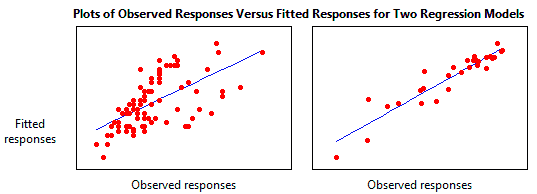
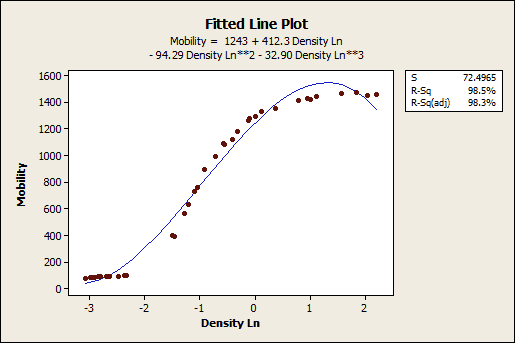
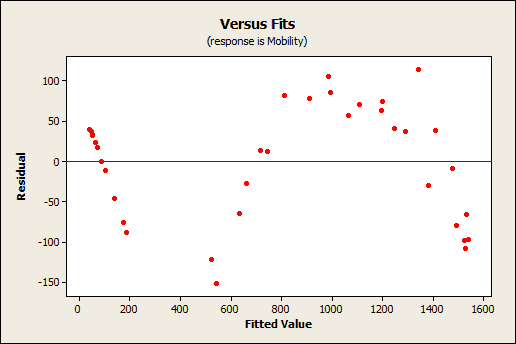
After you have fit a linear model using regression analysis, ANOVA, or design of experiments (DOE), you pauperism to limit how well the model fits the information. To help you out, Minitab applied math software presents a variety of good-of-fit statistics. In that post, we'll explore the R-squared (R2 ) statistic, some of its limitations, and uncover some surprises on the way. For case, reduced R-squared values are not always bad and high R-squared values are non forever good! Rectilinear regression calculates an equating that minimizes the distance between the fitted line and totally of the data points. Technically, ordinary least squares (OLS) regression minimizes the sum of the squared residuals. In general, a model fits the information well if the differences between the observed values and the poser's foretold values are small and unbiased. Before you deal the statistical measures for goodness-of-fit, you should jibe the residual plots. Substance plots can reveal unwanted residual patterns that indicate biased results more effectively than numbers. When your residual plots pass muster, you lavatory corporate trust your numeric results and check the goodness-of-fit statistics. R-squared is a statistical measure of how close the data are to the fitted regression line. It is also known as the coefficient of determination, or the coefficient of multiple determination for dual regression. The definition of R-squared is fairly straight-forward; IT is the percentage of the answer variable variation that is explained away a linear model. Or: R-squared = Explained variation / Total sport R-square is always between 0 and 100%: In general, the high the R-square, the better the model fits your data. However, there are important conditions for this guideline that I'll talk about both therein post and my next post. Plotting fitted values away observed values graphically illustrates different R-square values for regression models. The regression mould connected the left accounts for 38.0% of the variance while the one on the right accounts for 87.4%. The more variableness that is accounted for by the regression model the closer the data points will fall to the fitted regression line. Theoretically, if a model could excuse 100% of the variance, the fitted values would always equal the determined values and, therefore, all the data points would fall on the fitted regression curve. R-squaredcannot determine whether the coefficient estimates and predictions are biased, which is why you must assess the residual plots. R-squared does non indicate whether a regression model is adequate. You can have a low R-squared value for a good exemplary, or a high R-squared value for a model that does not fit the data! The R-squared in your output is a coloured estimate of the population R-squared. No! There are two major reasons wherefore it tin be just fine to take low R-squared values. In some fields, it is completely expected that your R-square values will be low. For example, any field of study that attempts to predict anthropoid deportment, so much American Samoa psychology, typically has R-squared values lower than 50%. Humans are simply harder to predict than, enounce, natural science processes. Furthermore, if your R-squared value is low but you have statistically significant predictors, you can still draw important conclusions about how changes in the predictor values are associated with changes in the reaction value. Regardless of the R-squared, the probatory coefficients still represent the mean change in the response for one whole of variety in the predictor while holding other predictors in the model never-ending. Obviously, this type of information can be extremely valuable. See a graphical instance of why a humbled R-squared doesn't affect the rendering of significant variables. A short R-squared is most problematic when you want to produce predictions that are reasonably precise (have a belittled enough prediction separation). How high should the R-squared be for prediction? Well, that depends on your requirements for the width of a anticipation interval and how so much variability is present in your data. While a high R-squared is required for precise predictions, it's non comfortable away itself, as we shall see. No! A high R-squared does non necessarily indicate that the mold has a trade good meet. That power embody a surprise, but look at the fitted line secret plan and residual plat below. The fitted line plot displays the family relationship 'tween semiconducting material electron mobility and the natural log of the density for real experimental data. The fitted personal credit line plot shows that these data follow a nice tight function and the R-square is 98.5%, which sounds great. Withal, look closer to see how the infantile fixation stoc consistently o'er and under-predicts the information (prejudice) at different points along the curve. You bum also see patterns in the Residuals versus Fits plot, rather than the randomness that you want to date. This indicates a bad fit, and serves as a reminder as to why you should always watch the residual plots. This example comes from my post about choosing 'tween linear and nonlinear regression. In this case, the answer is to use nonlinear regression because linear models are unable to fit the specific veer that these data travel along. However, same biases can take plac when your linear model is lacking important predictors, multinomial terms, and fundamental interaction terms. Statisticians call this specification bias, and it is caused by an underspecified poser. For this case of bias, you can fix the residuals away adding the proper terms to the model. For more information about how a high R-squared is not always good a thing, read my post Five Reasons Why Your R-squared Can Make up Too High. R-squared is a convenient, ostensibly intuitive measure of how wellspring your lengthwise role model fits a set of observations. Withal, Eastern Samoa we saw, R-square doesn't tell us the entire story. You should evaluate R-squared values in conjunction with residual plots, other model statistics, and subject area knowledge ready to fill out the envision (pardon the pun). Piece R-square provides an calculate of the strength of the relationship between your model and the response variable, it does not provide a formal hypothesis test for this human relationship. The F-test of boilers suit significance determines whether this kinship is statistically significant. In my next blog, we'll continue with the report that R-squared by itself is incomplete and take two strange types of R-squared: adjusted R-squared and foreseen R-squared. These two measures overcome specific problems in order to provide additive information by which you can evaluate your regression model's explanatory power. For more about R-squared, learn the answer to this eternal question: How high should R-squared equal? If you'Ra learning about reversion, read my regression tutorial! What Is Goodness-of-Sound for a Linear Model?
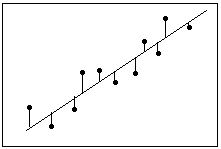 Definition: Residual = Discovered value - Fitted value
 What Is R-squared?
Written Representation of R-squared

Key Limitations of R-squared
Are Humble R-square Values Inherently Bad?
Are High R-squared Values Inherently Just?
Terminal Thoughts along R-squared

In Ibm Spss, Where in the Menu Can You Find the Chi-square Goodness-of-fit Statistic?
Source: https://blog.minitab.com/en/adventures-in-statistics-2/regression-analysis-how-do-i-interpret-r-squared-and-assess-the-goodness-of-fit
0 Response to "In Ibm Spss, Where in the Menu Can You Find the Chi-square Goodness-of-fit Statistic?"
Post a Comment