Usccb Readings Epiphany Mass Jan 5 2020
MASS READINGS
Jan 05, 2020 (Readings on USCCB website)
COLLECT PRAYER
May the splendor of your majesty, O Lord, we pray, shed its lite upon our hearts, that nosotros may pass through the shadows of this world and reach the brightness of our eternal abode. Through our Lord Jesus Christ, your Son, who lives and reigns with y'all in the unity of the Holy Spirit, God, for ever and ever.
bear witness
Recipes (35)
- Brazilian King's Bread
- Candied Fruit Skin -- Epiphany Souvenir
- Cappelletti all'uso di Romagna (Soup with Niggling Hats)
- Dutch King's Bread
- Epiphany Breadstuff
- Fave dei Morti II
- Fireside Dial
- Fresh Tomato Sauce
- Galette des Rois
- Gateau des Rois (1)
- Gateau des Rois (2)
- Insalata di Rinforzo
- King Cake (New Orleans' Style)
- King's Ring
- Kings' Bread Band
- Lamb Pie with Poppy Seed Crust
- Lamb'due south Wool I
- Lamb'south Wool II
- Lamb's Wool III
- Lamb's Wool Four
- Little Hats Cappelletti
- Little Mince Pies
- Mostarda di Cremona (Fruited Mustard)
- Pate de Noel (Christmas Pie)
- Rosca de Reyes
- Spanish Male monarch's Bread
- Castilian Rex'south Cake
- 12th Night Bread I
- 12th Night Bread II
- 12th Night Bread of Lady Carcas
- Twelfth Nighttime Block I
- Twelfth Nighttime Cake Two
- Twelfth Night Block III
- Twelfth Night Cake 4
- King's Block
show
Activities (xxx)
- A Children'due south Party for Twelfth Night
- A Christmas Play
- An Epiphany Drama
- Carnival or Mardi Gras
- Celebrating the Feast of the Epiphany
- Christmas and the Eucharist
- Christmas at Domicile and in the Liturgy
- Mean solar day Twelve ~ Activities for the Feast of Epiphany
- Day Twelve ~ Activities for the Twelfth Solar day of Christmas
- Enthroning the Crib for Epiphany
- Epiphany Cake Tradition
- Epiphany Crib Scene Figures
- Epiphany Feast Suggestions
- Epiphany Habitation Blessing Ceremony
- Epiphany Mass
- Epiphany Mass in an Eastern Rite
- Epiphany of Our Lord
- Epiphany Plays for the Family and Community
- Explanation of Epiphany, or the Manifestation of the Lord
- Family and Friends of Jesus Scrapbook Anthology
- Giving of Presents
- Kings' Party or Twelfth Dark Party
- Living the Liturgy in the Dwelling house for Appearance and Christmas
- Meaning of Epiphany
- Posters for Advent, Christmas, and Epiphany
- Singing and Acting
- The Feasts of Light: Christmas, Epiphany and Candlemas
- The Wise Men, An Epiphany Legend
- Tradition of the Epiphany Mystery Play
- Twelfth Nighttime Block And Kings Tradition
show
Prayers (26)
- Roman Ritual: Blessing of Chalk on Epiphany
- Blessing of the Home on Epiphany
- Procession to the Majestic Crib on Epiphany
- Christmas Morning Prayers
- Christmas Evening Prayers
- Epiphany Prayers for the Home (without Home Blessing)
- Summary of Epiphany Blessings from the Roman Ritual
- Christmas Table Blessing i
- Christmas Table Blessing 2
- Christmas Table Blessing 3
- Christmas Tabular array Blessing four
- Book of Blessings: Blessing of a Christmas Tree
- Book of Blessings: Approval of Homes During the Christmas and Easter Seasons
- Book of Blessings: Approving Before and After Meals: Christmas Season (2nd Plan)
- Epiphany Home Approving
- Volume of Blessings: Blessing of the Christmas Tree for the Abode (Shorter Rite)
- Epiphany Prayer from Mozarabic Breviary
- Epiphany Prayer - 2 from Mozarabic Breviary
- Roman Ritual: Blessing of Gold, Incense, and Myrrh on Epiphany
- Roman Ritual: Blessing of Homes on Epiphany
- Roman Ritual: Blessing of Water on Eve of Epiphany
- Roman Ritual: Litany of the Saints
- Epiphany Home Blessing Anniversary
- Epiphany Meal Blessing
- Solemn Announcing of Movable Feastdays on Epiphany
- Roman Ritual: Blessing of Eggs
show
Library (4)
- Exist An Epiphany Of Christ, Of His Merciful Love | Pope Saint John Paul Ii
- Benedict XVI Homily for Feast of the Epiphany 2011 | Pope Benedict Sixteen
- Epiphany Celebrates Church's Catholicity | Pope Saint John Paul 2
- The Epiphany of the Lord | Kilian J. Hennrich O.F.M., Cap., A.M.
show
Blog & Podcasts (4)
» Enjoy our Liturgical Seasons series of e-books!
Previous Agenda: Holy Proper name of Jesus
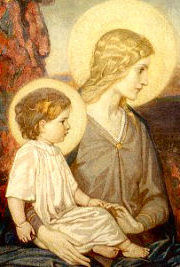 Today the Church celebrates the Solemnity of the Epiphany. "The Lord and ruler is coming; kingship is his, and regime and power." With these words the Church building proclaims that today's banquet brings to a perfect fulfillment all the purposes of Appearance. Epiphany, therefore, marks the liturgical zenith of the Appearance-Christmas season. — Pius Parsch

The Solemnity of the Epiphany is celebrated either on Jan half dozen or, according to the decision of the episcopal conference, on the Sun between Jan ii and January 8. The young Messiah is revealed as the light of the nations. Yet, as the antiphon for the Magnificat at Second Vespers reminds usa, three mysteries are encompassed in this solemnity: the adoration of the Christ Kid past the Magi, the Baptism of Christ and the wedding feast at Cana. Extra candles and/or lamps may exist placed around the sanctuary and in other parts of the church to honour Christ revealed as the Light of the Gentiles (Formalism of Bishops). It is customary to replace the images of the shepherds at the crib with the iii Magi and their gifts. — Ceremonies of the Liturgical Year, Msgr. Peter J. Elliott, Ignatius Press.
The feast of St. John Neumann, which is ordinarily celebrated today, is superseded past the Sunday liturgy.
Click here for commentary on the readings in the Boggling Form of the Roman Rite.
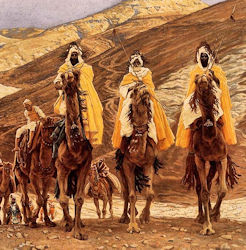 The feast of the Epiphany, which was kept in the East and in certain Western Churches before existence observed in Rome, seems to have been originally a feast of the nascency; January 6, for those churches where it was kept, was the equivalent of Christmas (December 25) in the Roman Church. The feast was introduced at Rome in the second half of the sixth century and became the complement and, so to say, the crown of the Christmas festival.
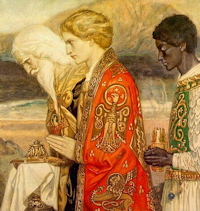
Epiphany ways manifestation. What the Church celebrates today is the manifestation of our Lord to the whole world; after being made known to the shepherds of Bethlehem He is revealed to the Magi who have come from the East to adore Him. Christian tradition has ever seen in the Magi the get-go fruits of the Gentiles; they lead in their wake all the peoples of the earth, and thus the Epiphany is an affirmation of universal conservancy. St. Leo brings out this signal admirably in a sermon, read at Matins, in which he shows in the adoration of the Magi the beginnings of Christian faith, the time when the great mass of the heathen sets off to follow the star which summons it to seek its Saviour.
That is the significant, as well, of the wonderful prophecy from Isaias which the liturgy appoints to be read in the starting time nocturn at Matins and at the Epistle of the Mass. This same thought of universal redemption the Church returns to as she sings, in the antiphon to the Magnificat at second Vespers, applying the words to herself, of the union with Christ typified by the hymeneals feast at Cana, by the baptism of her children foreshadowed past that of Christ in the waters of the Jordan. Formerly the Epiphany was an boosted day for solemn baptisms.
Solemnity of the Epiphany - Day Twelve
 Epiphany is a large commemoration, particularly in Spanish speaking countries. Things await different around the household: the infant Jesus in the manger now has a pocket-size gold crown and is wearing regal robes. The figures of the wise men have reached Bethlehem, completing the birth scene.
The Church extends itself on Epiphany to the homes of the true-blue. The custom of blessing the dwelling house on this day probably originated from these words in the Gospel, "And entering into the house, they institute the Child with Mary, His Female parent, and falling down they adored Him." The priest blesses the firm if he can be nowadays, merely if not, the father of the family unit may do so.
- Day Twelve activeness (Epiphany Party)
- 24-hour interval Twelve recipe (Twelfth Solar day Cake)
According to the 1962 Missal of St. John XXIII the Extraordinary Form of the Roman Rite today is the feast of the Holy Name of Jesus. In a Motu Proprio dated October 23, 1913, Pope St. Pius 10 moved this Banquet to the Lord's day between January 2-5, or January two if none of these days is a Lord's day.
Source: https://www.catholicculture.org/culture/liturgicalyear/calendar/day.cfm?date=2020-01-05
0 Response to "Usccb Readings Epiphany Mass Jan 5 2020"
Post a Comment