Bacilly Bãƒâ©nigne De A Commentary Upon the Art of Proper Singing


Singing is the deed of creating musical sounds with the voice.[1] [two] [3] A person who sings is called a singer or singer (in jazz and/or popular music).[4] [5] Singers perform music (arias, recitatives, songs, etc.) that can be sung with or without accompaniment by musical instruments. Singing is often done in an ensemble of musicians, such as a choir of singers or a band of instrumentalists. Singers may perform equally soloists or accompanied by anything from a single instrument (equally in fine art song or some jazz styles) upward to a symphony orchestra or big band. Dissimilar singing styles include art music such every bit opera and Chinese opera, Indian music, Japanese music and religious music styles such equally gospel, traditional music styles, world music, jazz, dejection, ghazal and popular music styles such as pop, rock and electronic dance music.
Singing can be formal or informal, arranged, or improvised. It may be washed as a grade of religious devotion, as a hobby, equally a source of pleasure, comfort, or ritual as part of music pedagogy or as a profession. Excellence in singing requires time, dedication, educational activity, and regular do. If practice is done regularly and so the sounds tin can become clearer and stronger.[6] Professional person singers commonly build their careers effectually one specific musical genre, such as classical or rock, although at that place are singers with crossover success (singing in more one genre). Professional person singers usually have phonation preparation provided by voice teachers or vocal coaches throughout their careers.
Voices [edit]
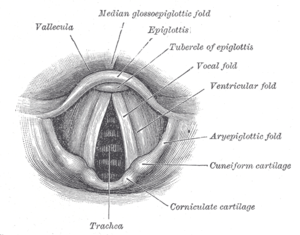
In its physical attribute, singing has a well-divers technique that depends on the use of the lungs, which human activity as an air supply or bellows; on the larynx, which acts as a reed or vibrator; on the chest, head cavities and the skeleton, which have the office of an amplifier, every bit the tube in a wind instrument; and on the natural language, which together with the palate, teeth, and lips articulate and impose consonants and vowels on the amplified sound. Though these four mechanisms role independently, they are nonetheless coordinated in the institution of a vocal technique and are made to collaborate upon one another.[seven] During passive breathing, air is inhaled with the diaphragm while exhalation occurs without any try. Exhalation may be aided past the abdominal, internal intercostal and lower pelvis/pelvic muscles. Inhalation is aided by employ of external intercostals, scalenes, and sternocleidomastoid muscles. The pitch is altered with the vocal cords. With the lips airtight, this is called humming.
The sound of each private's singing phonation is entirely unique not only because of the bodily shape and size of an individual's song cords, only too due to the size and shape of the rest of that person's trunk. Humans have vocal folds which can loosen, tighten, or modify their thickness, and over which jiff tin can be transferred at varying pressures. The shape of the chest and neck, the position of the tongue, and the tightness of otherwise unrelated muscles tin can exist altered. Any ane of these actions results in a modify in pitch, volume (loudness), timbre, or tone of the sound produced. Sound too resonates inside different parts of the body and an individual'southward size and bone structure can bear upon the audio produced by an individual.
Singers tin also learn to project sound in sure means so that it resonates better inside their vocal tract. This is known every bit vocal resonation. Another major influence on vocal sound and production is the function of the larynx which people can manipulate in different ways to produce different sounds. These unlike kinds of laryngeal function are described as different kinds of vocal registers.[8] The primary method for singers to accomplish this is through the utilize of the Vocalizer's Formant; which has been shown to friction match specially well to the almost sensitive part of the ear's frequency range.[nine] [10]
It has too been shown that a more powerful vocalization may exist achieved with a fatter and fluid-like vocal fold mucosa.[11] [12] The more than pliable the mucosa, the more than efficient the transfer of energy from the airflow to the vocal folds.[xiii]
Song classification [edit]
In European classical music and opera, voices are treated like musical instruments. Composers who write vocal music must have an understanding of the skills, talents, and vocal properties of singers. Vox classification is the process past which human singing voices are evaluated and are thereby designated into vocalism types. These qualities include simply are not limited to song range, vocal weight, song tessitura, vocal timbre, and vocal transition points such as breaks and lifts within the vox. Other considerations are physical characteristics, speech communication level, scientific testing, and vocal registration.[14] The scientific discipline behind phonation classification developed within European classical music has been slow in adapting to more modernistic forms of singing. Voice classification is often used within opera to acquaintance possible roles with potential voices. There are currently several unlike systems in utilize inside classical music including the German language Fach system and the choral music system amidst many others. No organisation is universally applied or accepted.[xv]
Yet, most classical music systems acknowledge seven different major voice categories. Women are typically divided into three groups: soprano, mezzo-soprano, and contralto. Men are commonly divided into 4 groups: countertenor, tenor, baritone, and bass. When because voices of pre-pubescent children an eighth term, treble, can be applied. Within each of these major categories, at that place are several sub-categories that identify specific vocal qualities like coloratura facility and vocal weight to differentiate between voices.[16]
Inside choral music, singers' voices are divided solely on the ground of song range. Choral music most unremarkably divides vocal parts into high and low voices within each sex (SATB, or soprano, alto, tenor, and bass/). Equally a result, the typical choral situation gives many opportunities for misclassification to occur.[sixteen] Since well-nigh people have medium voices, they must be assigned to a office that is either as well high or as well depression for them; the mezzo-soprano must sing soprano or alto and the baritone must sing tenor or bass. Either option tin present issues for the singer, but for most singers, there are fewer dangers in singing too low than in singing besides loftier.[17]
Within contemporary forms of music (sometimes referred to as contemporary commercial music), singers are classified by the style of music they sing, such as jazz, pop, blues, soul, country, folk, and rock styles. There is currently no authoritative voice classification arrangement within not-classical music. Attempts have been fabricated to prefer classical voice type terms to other forms of singing but such attempts have been met with controversy.[18] The evolution of voice categorizations were made with the understanding that the singer would exist using classical vocal technique inside a specified range using unamplified (no microphones) vocal product. Since gimmicky musicians use unlike vocal techniques, microphones, and are not forced to fit into a specific vocal role, applying such terms as soprano, tenor, baritone, etc. can be misleading or even inaccurate.[nineteen]
Vocal registration [edit]
Vocal registration refers to the system of vocal registers within the voice. A register in the voice is a particular series of tones, produced in the same vibratory pattern of the vocal folds, and possessing the same quality. Registers originate in laryngeal function. They occur considering the song folds are capable of producing several unlike vibratory patterns.[20] Each of these vibratory patterns appears within a particular range of pitches and produces certain characteristic sounds.[21] The occurrence of registers has also been attributed to effects of the acoustic interaction betwixt the vocal fold oscillation and the song tract.[22] The term "register" can exist somewhat disruptive as information technology encompasses several aspects of the voice. The term register can be used to refer to whatever of the following:[16]
- A particular part of the vocal range such as the upper, middle, or lower registers.
- A resonance surface area such equally chest voice or head vocalization.
- A phonatory process (vox is the process of producing vocal sound past the vibration of the vocal folds that is in plough modified by the resonance of the song tract)
- A certain vocal timbre or vocal "color"
- A region of the voice which is defined or delimited by vocal breaks.
In linguistics, a annals linguistic communication is a linguistic communication which combines tone and vowel vocalism into a unmarried phonological organisation. Within speech pathology, the term vocal register has three constituent elements: a sure vibratory pattern of the vocal folds, a sure series of pitches, and a certain type of sound. Speech communication pathologists identify four vocal registers based on the physiology of laryngeal part: the vocal fry register, the modal register, the falsetto annals, and the whistle register. This view is also adopted by many vocal pedagogues.[16]
Vocal resonation [edit]

Cantankerous-department of the head and cervix
Song resonation is the process past which the basic product of vocalization is enhanced in timbre and/or intensity by the air-filled cavities through which it passes on its manner to the outside air. Various terms related to the resonation process include amplification, enrichment, enlargement, improvement, intensification, and prolongation, although in strictly scientific usage acoustic authorities would question near of them. The main betoken to exist drawn from these terms past a singer or speaker is that the result of resonation is, or should exist, to make a amend sound.[xvi] There are seven areas that may exist listed as possible vocal resonators. In sequence from the lowest inside the body to the highest, these areas are the chest, the tracheal tree, the larynx itself, the pharynx, the oral crenel, the nasal cavity, and the sinuses.[23]
Chest voice and head vocalisation [edit]
Chest vox and head voice are terms used within vocal music. The use of these terms varies widely inside song pedagogical circles and there is currently no one consequent opinion among vocal music professionals in regards to these terms. Chest voice tin exist used in relation to a particular part of the vocal range or type of vocal register; a vocal resonance area; or a specific vocal timbre.[16] Caput phonation can exist used in relation to a particular office of the vocal range or type of vocal register or a vocal resonance surface area.[16] In Men, the caput voice is commonly referred to as the falsetto. The transition from and combination of chest voice and head vocalization is referred to every bit song mix or vocal mixing in the singer's performance.[24] Song mixing can exist inflected in specific modalities of artists who may concentrate on smooth transitions between chest voice and head vocalisation, and those who may use a "flip"[25] to describe the sudden transition from chest voice to caput voice for creative reasons and enhancement of vocal performances.
History and development [edit]
The kickoff recorded mention of the terms chest voice and head vocalisation was effectually the 13th century when it was distinguished from the "throat voice" (pectoris, guttoris, capitis—at this time it is probable that head voice referred to the falsetto register) by the writers Johannes de Garlandia and Jerome of Moravia.[26] The terms were later adopted inside bel canto, the Italian opera singing method, where chest voice was identified as the lowest and head voice the highest of three vocal registers: the chest, passagio, and head registers.[15] This approach is nevertheless taught by some vocal pedagogists today. Another current pop approach that is based on the bel canto model is to split both men and women's voices into three registers. Men's voices are divided into "breast register", "head register", and "falsetto register" and woman's voices into "chest register", "middle register", and "head register". Such pedagogists teach that the caput annals is a song technique used in singing to describe the resonance felt in the singer's caput.[27]
However, as knowledge of physiology has increased over the past two hundred years, so has the agreement of the physical process of singing and vocal production. Equally a result, many song pedagogists, such as Ralph Appelman at Indiana Academy and William Vennard at the University of Southern California, have redefined or even abandoned the utilize of the terms chest voice and head voice.[fifteen] In particular, the use of the terms chest register and head register accept become controversial since vocal registration is more unremarkably seen today equally a product of laryngeal function that is unrelated to the physiology of the breast, lungs, and head. For this reason, many vocal pedagogists argue that information technology is meaningless to speak of registers being produced in the chest or caput. They argue that the vibratory sensations which are felt in these areas are resonance phenomena and should be described in terms related to vocal resonance, not to registers. These vocal pedagogists prefer the terms chest voice and head voice over the term annals. This view believes that the problems which people identify as register bug are really problems of resonance adjustment. This view is also in alignment with the views of other academic fields that study vocal registration including voice communication pathology, phonetics, and linguistics. Although both methods are notwithstanding in use, current vocal pedagogical practice tends to prefer the newer more than scientific view. Also, some vocal pedagogists take ideas from both viewpoints.[16]
The gimmicky employ of the term chest vox often refers to a specific kind of vocal coloration or vocal timbre. In classical singing, its utilise is limited entirely to the lower part of the modal register or normal vox. Within other forms of singing, chest voice is oftentimes applied throughout the modal register. Chest timbre can add a wonderful array of sounds to a vocaliser's vocal interpretive palette.[28] However, the use of overly strong chest vocalism in the higher registers in an try to hitting higher notes in the breast tin lead to forcing. Forcing tin lead consequently to vocal deterioration.[29]
Vocal pedagogy [edit]

Vocal educational activity is the study of the teaching of singing. The art and science of vocal teaching has a long history that began in Aboriginal Greece[thirty] and continues to develop and change today. Professions that exercise the art and science of vocal education include vocal coaches, choral directors, song music educators, opera directors, and other teachers of singing.
Vocal pedagogy concepts are a part of developing proper song technique. Typical areas of study include the following:[31] [32]
- Anatomy and physiology as it relates to the concrete process of singing
- Vocal wellness and vocalism disorders related to singing
- Animate and air support for singing
- Phonation
- Vocal resonation or Vox project
- Vocal registration: a particular series of tones, produced in the same vibratory pattern of the vocal folds, and possessing the same quality, which originate in laryngeal role, considering each of these vibratory patterns appears inside a detail range of pitches and produces certain characteristic sounds.
- Voice nomenclature
- Song styles: for classical singers, this includes styles ranging from Lieder to opera; for pop singers, styles can include "belted out" a blues ballads; for jazz singers, styles tin can include Swing ballads and scatting.
- Techniques used in styles such as sostenuto and legato, range extension, tone quality, vibrato, and coloratura
Vocal technique [edit]
Singing when washed with proper vocal technique is an integrated and coordinated act that effectively coordinates the physical processes of singing. In that location are iv physical processes involved in producing vocal sound: respiration, phonation, resonation, and articulation. These processes occur in the following sequence:
- Breath is taken
- Sound is initiated in the larynx
- The vocal resonators receive the audio and influence it
- The articulators shape the sound into recognizable units
Although these 4 processes are oft considered separately when studied, in actual exercise, they merge into one coordinated function. With an effective vocaliser or speaker, 1 should rarely be reminded of the procedure involved equally their mind and body are then coordinated that one only perceives the resulting unified function. Many vocal issues issue from a lack of coordination within this procedure.[nineteen]
Since singing is a coordinated human activity, it is hard to discuss any of the individual technical areas and processes without relating them to others. For example, phonation only comes into perspective when it is continued with respiration; the articulators touch resonance; the resonators touch the vocal folds; the vocal folds touch breath control; and so along. Vocal bug are often a result of a breakdown in ane part of this coordinated procedure which causes vox teachers to frequently focus intensively on one area of the procedure with their student until that result is resolved. Even so, some areas of the fine art of singing are so much the outcome of coordinated functions that it is hard to discuss them under a traditional heading like vocalization, resonation, articulation, or respiration.
In one case the voice student has become aware of the concrete processes that make up the human activity of singing and of how those processes office, the student begins the task of trying to coordinate them. Inevitably, students and teachers volition become more concerned with one area of the technique than another. The various processes may progress at different rates, with a resulting imbalance or lack of coordination. The areas of vocal technique which seem to depend most strongly on the student's ability to coordinate diverse functions are:[sixteen]
- Extending the vocal range to its maximum potential
- Developing consistent song production with a consistent tone quality
- Developing flexibility and agility
- Achieving a counterbalanced vibrato
- A blend of chest and head vocalisation on every note of the range[33]
Developing the singing vocalism [edit]
Singing is a skill that requires highly developed muscle reflexes. Singing does not crave much musculus strength but information technology does crave a loftier degree of muscle coordination. Individuals can develop their voices further through the conscientious and systematic practice of both songs and song exercises. Vocal exercises have several purposes, including[16] warming up the phonation; extending the vocal range; "lining up" the vocalisation horizontally and vertically; and acquiring vocal techniques such as legato, staccato, command of dynamics, rapid figurations, learning to sing wide intervals comfortably, singing trills, singing melismas and correcting vocal faults.
Vocal pedagogists instruct their students to practise their voices in an intelligent mode. Singers should be thinking constantly about the kind of audio they are making and the kind of sensations they are feeling while they are singing.[19]
Learning to sing is an activity that benefits from the involvement of an instructor. A singer does not hear the same sounds inside his or her head that others hear outside. Therefore, having a guide who can tell a student what kinds of sounds he or she is producing guides a singer to empathise which of the internal sounds correspond to the desired sounds required by the way of singing the pupil aims to re-create.[ citation needed ]
Extending vocal range [edit]
An important goal of vocal development is to larn to sing to the natural limits[34] of one's vocal range without any obvious or distracting changes of quality or technique. Song pedagogists teach that a singer can only achieve this goal when all of the physical processes involved in singing (such equally laryngeal activeness, jiff support, resonance adjustment, and articulatory movement) are effectively working together. Nearly song pedagogists believe in analogous these processes by (1) establishing practiced vocal habits in the most comfortable tessitura of the voice, and and so (ii) slowly expanding the range.[8]
In that location are three factors that significantly affect the ability to sing higher or lower:
- The energy factor – "energy" has several connotations. It refers to the full response of the body to the making of audio; to a dynamic human relationship between the animate-in muscles and the breathing-out muscles known equally the breath support mechanism; to the amount of breath pressure level delivered to the vocal folds and their resistance to that pressure; and to the dynamic level of the audio.
- The space factor – "space" refers to the size of the within of the mouth and the position of the palate and larynx. Generally speaking, a singer's mouth should be opened wider the college he or she sings. The internal space or position of the soft palate and larynx can be widened by relaxing the pharynx. Vocal pedagogists describe this as feeling like the "beginning of a yawn".
- The depth factor – "depth" has two connotations. It refers to the actual physical sensations of depth in the body and vocal machinery, and to mental concepts of depth that are related to tone quality.
McKinney says, "These three factors can be expressed in iii basic rules: (1) As you lot sing higher, you must use more energy; as you sing lower, y'all must use less. (two) Equally you sing higher, you must use more space; as y'all sing lower, you must apply less. (3) Every bit you sing higher, you must utilize more depth; as you sing lower, you must utilize less."[16]
Posture [edit]
The singing process functions best when certain physical weather of the body are put in place. The ability to movement air in and out of the body freely and to obtain the needed quantity of air tin exist seriously afflicted by the posture of the diverse parts of the breathing machinery. A sunken breast position volition limit the capacity of the lungs, and a tense intestinal wall volition inhibit the down travel of the diaphragm. Good posture allows the breathing machinery to fulfill its basic role efficiently without any undue expenditure of energy. Adept posture also makes information technology easier to initiate phonation and to melody the resonators as proper alignment prevents unnecessary tension in the body. Song pedagogists have besides noted that when singers assume skillful posture it oftentimes provides them with a greater sense of cocky-assurance and poise while performing. Audiences besides tend to answer better to singers with good posture. Habitual skillful posture besides ultimately improves the overall health of the body by enabling amend claret circulation and preventing fatigue and stress on the torso.[8]
At that place are eight components of the ideal singing posture:
- Anxiety slightly apart
- Legs directly but knees slightly aptitude
- Hips facing direct forward
- Spine aligned
- Belly apartment
- Chest comfortably frontwards
- Shoulders down and dorsum
- Head facing straight forward
Animate and breath back up [edit]
Natural breathing has three stages: a breathing-in period, breathing out period, and a resting or recovery period; these stages are not usually consciously controlled. Within singing, there are four stages of breathing: a animate-in flow (inhalation); a setting up controls catamenia (suspension); a controlled exhalation menses (phonation); and a recovery catamenia.
These stages must be under conscious control past the singer until they become conditioned reflexes. Many singers abandon conscious controls before their reflexes are fully conditioned which ultimately leads to chronic vocal bug.[35]
Vibrato [edit]
Vibrato is a technique in which a sustained annotation wavers very quickly and consistently between a higher and a lower pitch, giving the annotation a slight quaver. Vibrato is the pulse or wave in a sustained tone. Vibrato occurs naturally and is the result of proper jiff support and a relaxed vocal apparatus.[36] Some studies have shown that vibrato is the result of a neuromuscular tremor in the vocal folds. In 1922 Max Schoen was the first to make the comparison of vibrato to a tremor due to change in amplitude, lack of automatic control and it being half the rate of normal muscular discharge.[37] Some singers employ vibrato as a means of expression. Many successful artists can sing a deep, rich vibrato.
Extended vocal technique [edit]
Extended vocal techniques include rapping, screaming, growling, overtones, sliding. falsetto, yodeling, belting, apply of vocal fry register, using sound reinforcement systems, among others. A audio reinforcement organization is the combination of microphones, signal processors, amplifiers, and loudspeakers. The combination of such units may also employ reverb, repeat chambers and Motorcar-Tune among other devices.
Vocal music [edit]
Vocal music is music performed by one or more than singers, which are typically called songs, and which may be performed with or without instrumental accompaniment, in which singing provides the chief focus of the piece. Vocal music is probably the oldest grade of music since it does not require whatsoever musical instrument or equipment besides the phonation. All musical cultures have some form of vocal music and there are many long-standing singing traditions throughout the world'southward cultures. Music which employs singing simply does not feature it prominently is generally considered instrumental music. For case, some dejection rock songs may take a short, simple phone call-and-response chorus, only the accent in the song is on the instrumental melodies and improvisation. Song music typically features sung words called lyrics, although at that place are notable examples of vocal music that are performed using non-linguistic syllables or noises, sometimes equally musical onomatopoeia. A short piece of vocal music with lyrics is broadly termed a vocal, although, in classical music, terms such as aria are typically used.
Genres of vocal music [edit]

A trio of female singers performing at the Berwald Hall in 2016.
Song music is written in many different forms and styles which are often labeled within a item genre of music. These genres include popular music, art music, religious music, secular music, and fusions of such genres. Inside these larger genres are many subgenres. For example, popular music would encompass dejection, jazz, land music, easy listening, hip hop, rock music, and several other genres. At that place may too be a subgenre inside a subgenre such equally vocalese and scat singing in jazz.
Popular and traditional music [edit]
In many modern pop musical groups, a lead singer performs the main vocals or melody of a song, as opposed to a backing vocaliser who sings fill-in vocals or the harmony of a song. Bankroll vocalists sing some, but unremarkably, not all, parts of the vocal frequently singing merely in a song's refrain or humming in the background. An exception is five-part gospel a cappella music, where the lead is the highest of the five voices and sings a descant and not the melody. Some artists may sing both the lead and backing vocals on audio recordings by overlapping recorded vocal tracks.
Popular music includes a range of vocal styles. Hip hop uses rapping, the rhythmic delivery of rhymes in a rhythmic oral communication over a beat or without accompaniment. Some types of rapping consist by and large or entirely of oral communication and chanting, like the Jamaican "toasting". In some types of rapping, the performers may interpolate brusque sung or half-sung passages. Blues singing is based on the use of the blue notes–notes sung at a slightly lower pitch than that of the major scale for expressive purposes. In heavy metallic and hardcore punk subgenres, vocal styles tin include techniques such as screams, shouts, and unusual sounds such as the "decease growl".
One difference between alive performances in the popular and Classical genres is that whereas Classical performers often sing without distension in modest- to mid-size halls, in popular music, a microphone and PA arrangement (amplifier and speakers) are used in almost all performance venues, fifty-fifty a modest coffee house. The use of the microphone has had several impacts on popular music. For one, information technology facilitated the evolution of intimate, expressive singing styles such as "crooning" which would not have enough projection and book if done without a microphone. Equally well, pop singers who use microphones can do a range of other vocal styles that would non project without amplification, such as making whispering sounds, humming, and mixing half-sung and sung tones. Every bit well, some performers utilize the microphone's response patterns to create effects, such as bringing the mic very shut to the mouth to get an enhanced bass response, or, in the instance of hip-hop beatboxers, doing plosive "p" and "b" sounds into the mic to create percussive effects. In the 2000s, controversy arose over the widespread use of electronic Car-Tune pitch correction devices with recorded and live pop music vocals. Controversy has likewise arisen due to cases where pop singers take been found to exist lip-syncing to a pre-recorded recording of their vocal functioning or, in the case of the controversial human activity Milli Vanilli, lip-syncing to tracks recorded by other uncredited singers.
While some bands use fill-in singers who only sing when they are on stage, it is common for fill-in singers in popular music to take other roles. In many stone and metallic bands, the musicians doing backup vocals as well play instruments, such equally rhythm guitar, electric bass, or drums. In Latin or Afro-Cuban groups, backup singers may play percussion instruments or shakers while singing. In some pop and hip hop groups and in musical theater, the fill-in singers may be required to perform elaborately choreographed dance routines while they sing through headset microphones.
Careers [edit]
The salaries and working weather for vocalists vary a bang-up deal. While jobs in other music fields such as music educational activity choir conductors tend to exist based on total-time, salaried positions, singing jobs tend to be based on contracts for private shows or performances, or for a sequence of shows
Aspiring singers and vocalists must have musical skills, an excellent voice, the power to work with people, and a sense of showmanship and drama. Additionally, singers need to take the ambition and bulldoze to continually study and improve,[38] Professional singers continue to seek out vocal coaching to strop their skills, extend their range, and acquire new styles. Too, aspiring singers need to proceeds specialized skills in the vocal techniques used to interpret songs, larn about the vocal literature from their chosen fashion of music, and proceeds skills in choral music techniques, sight singing and memorizing songs, and song exercises.
Some singers acquire other music jobs, such equally the composing, music producing and songwriting. Some singers put videos on YouTube and streaming apps. Singers market place themselves to buyers of vocal talent, by doing auditions in front end of a music manager. Depending on the style of vocal music that a person has trained in, the "talent buyers" that they seek out may exist record company, A&R representatives, music directors, choir directors, nightclub managers, or concert promoters. A CD or DVD with excerpts of vocal performances is used to demonstrate a singer's skills. Some singers hire an agent or director to help them to seek out paid engagements and other operation opportunities; the agent or managing director is oftentimes paid by receiving a pct of the fees that the singer gets from performing onstage.
Singing competitions [edit]
![[icon]](https://upload.wikimedia.org/wikipedia/commons/thumb/1/1c/Wiki_letter_w_cropped.svg/20px-Wiki_letter_w_cropped.svg.png) | This department is empty. You tin can help by adding to it. (April 2022) |
Singing and language [edit]
Every speech, natural or non-natural linguistic communication has its own intrinsic musicality which affects singing by means of pitch, phrasing, and accent.
Neurological aspects [edit]
Much research has been washed recently on the link betwixt music and language, especially singing. It is becoming increasingly clear that these two processes are very much alike, and yet too different. Levitin describes how, showtime with the eardrum, audio waves are translated into pitch, or a tonotopic map, and then shortly thereafter "speech and music probably diverge into separate processing circuits" (130).[39] At that place is evidence that neural circuits used for music and linguistic communication may start out in infants undifferentiated. There are several areas of the brain that are used for both language and music. For example, Brodmann area 47, which has been implicated in the processing of syntax in oral and sign languages, as well as musical syntax and semantic aspects of language. Levitin recounts how in certain studies, "listening to music and attention its syntactic features," similar to the syntactic processes in language, activated this part of the brain. In addition, "musical syntax ... has been localized to ... areas adjacent to and overlapping with those regions that process speech syntax, such as Broca's area" and "the regions involved in musical semantics .. appear to be [localized] almost Wernicke's area." Both Broca'southward area and Wernicke'due south area are important steps in language processing and product.
Singing has been shown to help stroke victims recover speech communication. According to neurologist Gottfried Schlaug, there is a corresponding area to that of spoken language, which resides in the left hemisphere, on the right side of the encephalon.[40] This is casually known equally the "singing center." By teaching stroke victims to sing their words, this tin help train this area of the brain for speech. In support of this theory, Levitin asserts that "regional specificity," such as that for speech, "may be temporary, as the processing centers for important mental functions actually move to other regions subsequently trauma or brain damage."[39] Thus in the right hemisphere of the brain, the "singing middle" may be retrained to help produce speech.[41]
Accents and singing [edit]
| | This section needs expansion. You can help past calculation to information technology. (January 2013) |
The speaking dialect or accent of a person may differ greatly from the general singing emphasis that a person uses while singing. When people sing, they mostly use the emphasis or neutral emphasis that is used in the style of music they are singing in, rather than a regional accent or dialect; the style of music and the popular eye/region of the style has more than influence on the singing accent of a person than where they come from. For example, in the English language linguistic communication, British singers of stone or popular music often sing in an American accent or neutral emphasis instead of an English accent.[42] [43]
Meet besides [edit]
- List of multilingual bands and artists
- Sign singing
Fine art music [edit]
- A cappella
- Aria
- Bel canto
- Chanson
- Chiaroscuro (music)
- Kid vocalizer
- Choral music
- Fach
- Group singing
- Opera
- Overtone singing
- Recitative
- Vocaliser-songwriter
- Sprechgesang
- Throat singing
- Vox pedagogy
- Voice projection
- Vox type
- Yodeling
- Winsingad
Other music [edit]
- Trounce boxing
- Belt (music)
- Death growl
- Humming
- Isicathamiya
- Kulning
- Pb vocalist
- Mbube
- Rapping
- Screaming (music)
- Vocoder
Physiology [edit]
- North-acylethanolamine (NAE)
References [edit]
- ^ "Definition of SINGING". world wide web.merriam-webster.com . Retrieved 18 January 2021.
- ^ "Definition of sing | Dictionary.com". www.dictionary.com . Retrieved eighteen January 2021.
- ^ Visitor, Houghton Mifflin Harcourt Publishing. "The American Heritage Dictionary entry: singing". ahdictionary.com . Retrieved 18 January 2021.
- ^ "Vocalizer – meaning in the Cambridge English Dictionary". Dictionary.cambridge.org . Retrieved 30 Jan 2019.
- ^ "Vocalist | Definition of vocalist in US English by Oxford Dictionaries".
- ^ Falkner, Keith, ed. (1983). Vocalisation. Yehudi Menuhin music guides. London: MacDonald Young. p. 26. ISBN978-0-356-09099-three. OCLC 10418423.
- ^ "Singing". Britannica Online Encyclopedia.
- ^ a b c polka dots Vennard, William (1967). Singing: the machinery and the technic. New York: Carl Fischer Music. ISBN978-0-8258-0055-9. OCLC 248006248.
- ^ Hunter, Eric J; Titze, Ingo R (2004). "Overlap of hearing and voicing ranges in singing" (PDF). Journal of Singing. 61 (iv): 387–392. PMC2763406. PMID 19844607.
- ^ Hunter, Eric J; Švec, Jan G; Titze, Ingo R (December 2006). "Comparison of the produced and perceived voice range profiles in untrained and trained classical singers". J Vox. twenty (4): 513–526. doi:ten.1016/j.jvoice.2005.08.009. PMC4782147. PMID 16325373.
- ^ Titze, I. R. (23 September 1995). "What's in a voice". New Scientist: 38–42.
- ^ Speak and Choke i, by Karl Southward. Kruszelnicki, ABC Science, News in Science, 2002
- ^ Lucero, Jorge C. (1995). "The minimum lung pressure to sustain vocal fold oscillation". The Journal of the Acoustical Order of America. 98 (2): 779–784. Bibcode:1995ASAJ...98..779L. doi:x.1121/1.414354. ISSN 0001-4966. PMID 7642816. S2CID 24053484.
- ^ Shewan, Robert (January–Feb 1979). "Voice classification: An examination of methodology". The NATS Bulletin. 35 (iii): 17–27. ISSN 0884-8106. OCLC 16072337.
- ^ a b c Stark, James (2003). Bel Canto: A history of vocal pedagogy. Toronto: University of Toronto Press. ISBN978-0-8020-8614-3. OCLC 53795639.
- ^ a b c d e f g h i j m McKinney, James C (1994). The diagnosis and correction of song faults. Nashville, TN: Genovex Music Group. p. 213. ISBN978-1-56593-940-0. OCLC 30786430.
- ^ Smith, Brenda; Thayer Sataloff, Robert (2005). Choral instruction. San Diego, CA: Plural Publishing. ISBN978-1-59756-043-half-dozen. OCLC 64198260.
- ^ Peckham, Anne (2005). Song workouts for the gimmicky vocalist. Boston: Berklee Printing. pp. 117. ISBN978-0-87639-047-4. OCLC 60826564.
- ^ a b c Appelman, Dudley Ralph (1986). The scientific discipline of vocal pedagogy: theory and application. Bloomington, IN: Indiana University Press. p. 434. ISBN978-0-253-35110-four. OCLC 13083085.
- ^ Lucero, Jorge C. (1996). "Breast‐ and falsetto‐like oscillations in a two‐mass model of the song folds". The Journal of the Acoustical Society of America. 100 (5): 3355–3359. Bibcode:1996ASAJ..100.3355L. doi:ten.1121/1.416976. ISSN 0001-4966.
- ^ Large, John West (February–March 1972). "Towards an integrated physiologic-acoustic theory of vocal registers". The NATS Message. 28: 30–35. ISSN 0884-8106. OCLC 16072337.
- ^ Lucero, Jorge C.; Lourenço, Kélem Thou.; Hermant, Nicolas; Hirtum, Annemie Van; Pelorson, Xavier (2012). "Result of source–tract acoustical coupling on the oscillation onset of the vocal folds" (PDF). The Journal of the Acoustical Society of America. 132 (1): 403–411. Bibcode:2012ASAJ..132..403L. doi:10.1121/one.4728170. ISSN 0001-4966. PMID 22779487.
- ^ Margaret C. 50. Greene; Mathieson, Lesley (2001). The phonation and its disorders (sixth ed.). John Wiley & Sons. ISBN978-1-86156-196-1. OCLC 47831173.
- ^ "What is Breast Vocalisation, Head Vocalization, and Mix?" by KO NAKAMURA. SWVS periodical. MARCH xi, 2017. [1]
- ^ Nickson|commencement=Chris|championship=Mariah Carey revisited: her story|year=1998|publisher=St. Martin's Press|page 32|isbn=978-0-312-19512-0
- ^ Grove, George; Sadie, Stanley, eds. (1980). The New Grove Lexicon of Music & Musicians. Vol. six: Edmund to Fryklunde. Macmillan. ISBN978-1-56159-174-9. OCLC 191123244.
- ^ Clippinger, David Alva (1917). The head vocalization and other problems: Practical talks on singing. Oliver Ditson. p. 12.
- Singing at Project Gutenberg
- ^ Miller, Richard (2004). Solutions for singers. Oxford: Oxford University Press. p. 286. ISBN978-0-nineteen-516005-5. OCLC 51258100.
- ^ Warrack, John Hamilton; W, Ewan (1992). The Oxford dictionary of opera . Oxford: Oxford Academy Press. ISBN978-0-19-869164-8. OCLC 25409395.
- ^ "Ancient Greek Music". Globe History Encyclopedia . Retrieved 19 June 2017.
- ^ Titze Ingo R (2008). "The homo instrument". Scientific American. 298 (1): 94–101. Bibcode:2008SciAm.298a..94T. doi:10.1038/scientificamerican0108-94. PMID 18225701.
- ^ Titze Ingo R (1994). Principles of vocalization production. Prentice Hall. p. 354. ISBN978-0-thirteen-717893-3.
- ^ Ramsey, Matt (24 June 2020). "ten Singing Techniques to Improve Your Singing Voice". Ramsey Voice Studio.
- ^ "Is information technology good to take natural coughing syrup to sing". VisiHow.
- ^ Sundberg, Johan (January–February 1993). "Breathing behavior during singing" (PDF). The NATS Periodical. 49: two–ix, 49–51. ISSN 0884-8106. OCLC 16072337. Archived (PDF) from the original on 29 May 2019.
- ^ Fulford, Phyllis; Miller, Michael (2003). The Complete Idiot's Guide to Singing. Penguin Books. p. 64.
- ^ Stark, James (2003). Bel Canto: A History of Vocal Didactics. University of Toronto Press. p. 139. ISBN978-0-8020-8614-3.
- ^ "National Association for Music Didactics (NAfME)". Menc.org. 29 June 2017. Archived from the original on xx April 2012. Retrieved 22 July 2017.
- ^ a b Levitin, Daniel J. (2006). This is Your Brain on Music: The Science of a Human Obsession. New York: Feather. ISBN978-0-452-28852-2.
- ^ "Singing 'rewires' damaged brain". BBC News. 21 February 2010. Archived from the original on 17 Dec 2018. Retrieved 6 December 2015.
- ^ Loui, Psyche; Wan, Catherine Y.; Schlaug, Gottfried (July 2010). "Neurological Bases of Musical Disorders and Their Implications for Stroke Recovery" (PDF). Acoustics Today. vi (3): 28–36. doi:x.1121/1.3488666. PMC3145418. PMID 21804770.
- ^ Alleyne, Richard (2 August 2010). "Stone 'north' roll all-time sung in American accents". The Daily Telegraph. Archived from the original on 6 August 2010. Retrieved 9 Jan 2013.
- ^ Anderson, L.V. (19 Nov 2012). "Why Practice British Singers Sound American?". Slate . Retrieved 9 January 2013.
Further reading [edit]
- Blackwood, Alan. The Performing World of the Singer. London: Hamish Hamilton, 1981. 113 p., handsomely ill. (mostly with photos.). ISBN 0-241-10588-9
- Reid, Cornelius. A Dictionary of Vocal Terminology: an Assay. New York: J. Patelson Music House, 1983. ISBN 0-915282-07-0
External links [edit]
 | Wikiquote has quotations related to: Singing |
 | Expect up vocal or singing in Wiktionary, the costless lexicon. |
 | Wikibooks has more than on the topic of: Singing |
- A Brief History of Singing
- Singing and Health: A systematic mapping and review of non-clinical research
Source: https://en.wikipedia.org/wiki/Singing
0 Response to "Bacilly Bãƒâ©nigne De A Commentary Upon the Art of Proper Singing"
Post a Comment